

What the rule requires
Nasdaq filed the proposal on January 13, 2026. The Commission instituted proceedings in April, Nasdaq amended the filing in June to add a limited exception at the hearings stage, and the Commission approved it on July 22, 2026 in Release No. 34-105971. The order sets no phase-in.
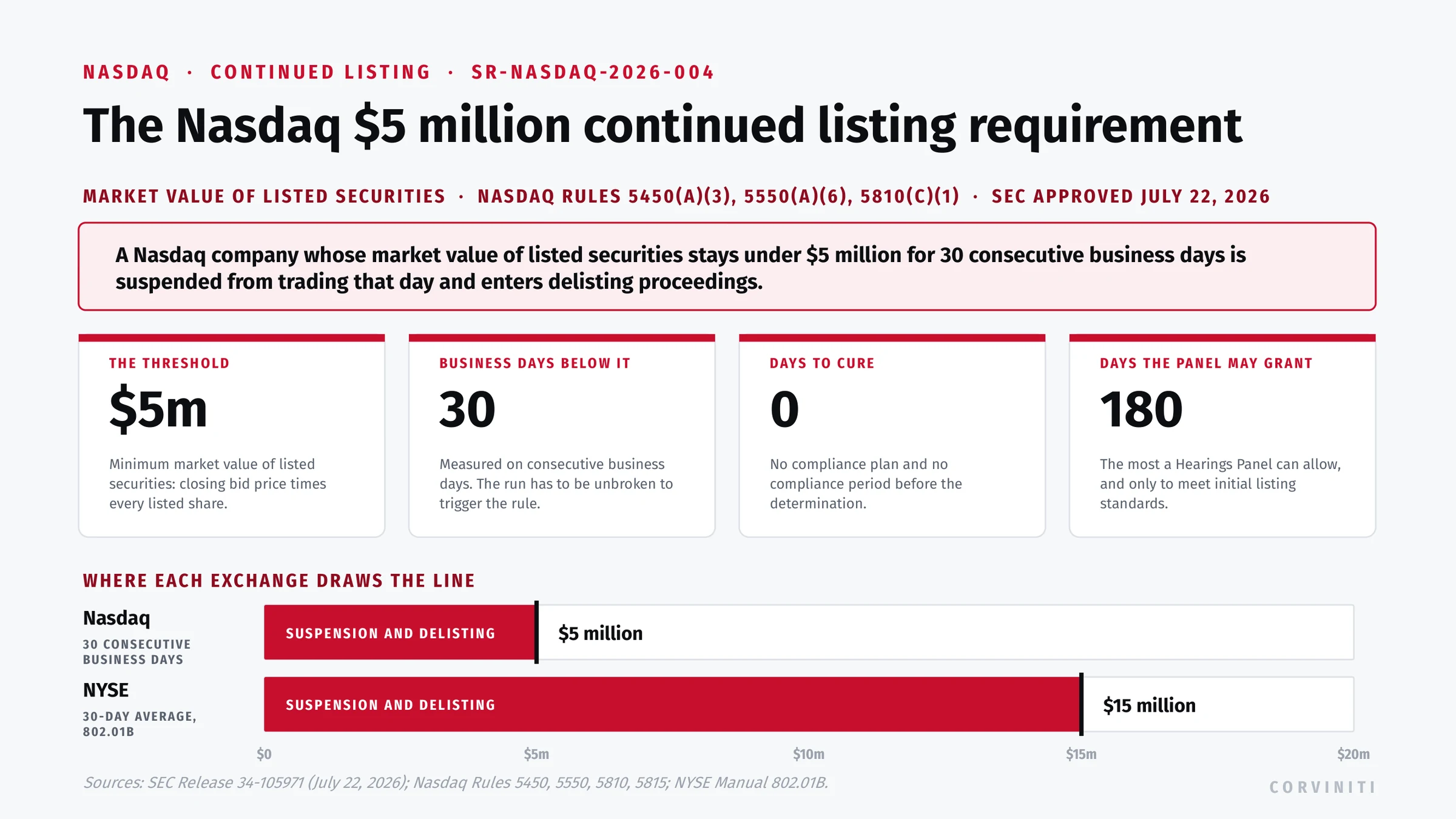
New Rules 5450(a)(3) and 5550(a)(6) require a minimum market value of listed securities of $5 million across all three Nasdaq tiers. The measure is the consolidated closing bid price times every share listed on Nasdaq, so it counts shares outside the public float. Under amended Rule 5810(c)(1), 30 consecutive business days below the line brings immediate suspension and delisting, with no compliance plan or cure period. Amended Rule 5815(a)(1)(B) removes the automatic stay, so a hearing request does not restore trading and the shares generally move to the over-the-counter market. New Rule 5815(c)(1)(I) lets the Hearings Panel reverse a determination made in error, or grant up to 180 days for the company to show it meets Nasdaq’s initial listing standards, which sit higher than the ones it just failed.
Commission analysis of Nasdaq and NYSE American data from 2006 to 2025 counted the issuers that would have failed rising from 2 in 2021 to 140 in 2023, then 122 in 2024 and 91 in 2025. The design follows NYSE American’s SR-NYSEAMER-2024-72 and brings Nasdaq closer to NYSE, where Section 802.01B of the Listed Company Manual triggers prompt suspension and delisting below a $15 million average global market capitalization over 30 consecutive trading days.
The case for the rule
Nasdaq’s position is that a market value under $5 million signals problems that are rarely temporary, often precedes other listing deficiencies, and leaves a security cheap to manipulate. The Commission supplied the number that carried the rule: 65% of issuers that failed the test were still under $5 million 180 days later, median under $3.7 million. That is what it cited when it declined to add a cure period.
Support came from market structure firms and investor advocates. SIFMA estimated that the number of Nasdaq securities trading under $1.00 rose 39% between 2020 and March 2026 and, citing InvestorLink data, that retail investors lost around $15 billion to ramp-and-dump schemes in 2025. The Security Traders Association argued a bright-line test is faster to administer and harder to evade than a subjective one. Citadel wrote that compliance periods “have previously allowed issuers to avoid timely delisting”.
The case against
Critics argue a fixed threshold with a 30 day clock and no cure period is easy to force: short sellers need only drive the value below $5 million and hold it there. One letter called the rule “a roadmap for predatory investors to force companies off the exchange”. Nasdaq answered that manipulation is illegal and that no evidence was offered, and the Commission found only that the 30 day requirement “could mitigate” the risk.
The Small Public Company Coalition filed a study by Professor Craig M. Lewis. Of about 816 companies that fell below $5 million for 30 days between 2006 and 2025, 78% recovered above the line at some point, 45% were never delisted, and 212 now trade above $5 million with more than $22 billion in combined value. The Commission accepted that the rule “may result in the delisting of companies that later recover” and approved it anyway.
Commenters also argued it works against the goal of reviving small business capital formation and reversing the decline in the number of US public companies, pushing issuers toward private markets where retail investors get less disclosure. The Commission did not take up requests for an averaging method, a 120 day period, or a 12 month delay, for a procedural reason: they “are not part of Nasdaq’s proposal,” and under Section 19(b) it must approve a filing it finds consistent with the Exchange Act.
What listed companies should do now
A reverse split will not help. It cuts shares and raises the price by the same factor, so market value is unchanged; it cures a bid price deficiency, not this one. Only issuing shares for value or a recovery in the price moves the measure.
Plan against the 30 day window, because the deficiency letter and the suspension arrive together. Companies near the line should track the number daily, size the issuance needed to clear $5 million with margin, and have financing documented before the count starts. If it runs out, the only route back is the panel exception, which requires meeting initial listing standards within 180 days.
Market value is not the only immediate trigger. Under Nasdaq Rule 5810(c)(3)(A)(iii), a closing bid price of $0.10 or less for ten consecutive business days also brings a Staff Delisting Determination and suspension, with no compliance period.
A suspension and a move to the over-the-counter market also affect Form S-3 eligibility, shelf registrations, warrant and equity line terms, covenants that reference exchange listing, and the going concern assessment.