The path from private-company books to an effective S-1 is a list of gaps to close. Below are the six where IPOs actually slip, what the S-1 will demand from each, and how we fix them.
We measure the distance to an effective S-1, then close it: the audit uplift, the positions, the controls, and the close process, in the order they gate your filing.
What going public requires, and how Corviniti closes the gaps
Key takeaways
What it is. The gap-closing work between private-company books and an effective S-1: the audited financial statements, technical accounting positions, controls, tax provision, and close process the filing requires.
Where it breaks. Most private companies have real gaps in each area, and the ones that move a timeline, an audit that cannot support the S-1, an undocumented position, a close that misses a public deadline, are visible in month one to anyone who looks.
How we help. We assess where you stand across all six areas, prepare what the filing needs, and run the close so your team is not carrying two jobs at once.
Going public means your financial statements, technical accounting, controls, tax provision, and close process all have to meet a public-company standard by the day you file. Most private companies have real gaps in each. IPO readiness is the work of finding those gaps and closing them before they move your timeline, whether you go public through a traditional IPO, a direct listing, or a SPAC.
Corviniti does that work with you. We assess where you stand, prepare the audited financial statements, position memos, controls, and tax provision the filing needs, and run the close so your team is not carrying two jobs at once. The six sections below cover each area: what the SEC and your auditors will require, and how we handle it. For a fast read on where you stand, the free readiness assessment scores all six in about fifteen minutes.
The readiness clock
The readiness timeline: sixteen weeks from kickoff to filing
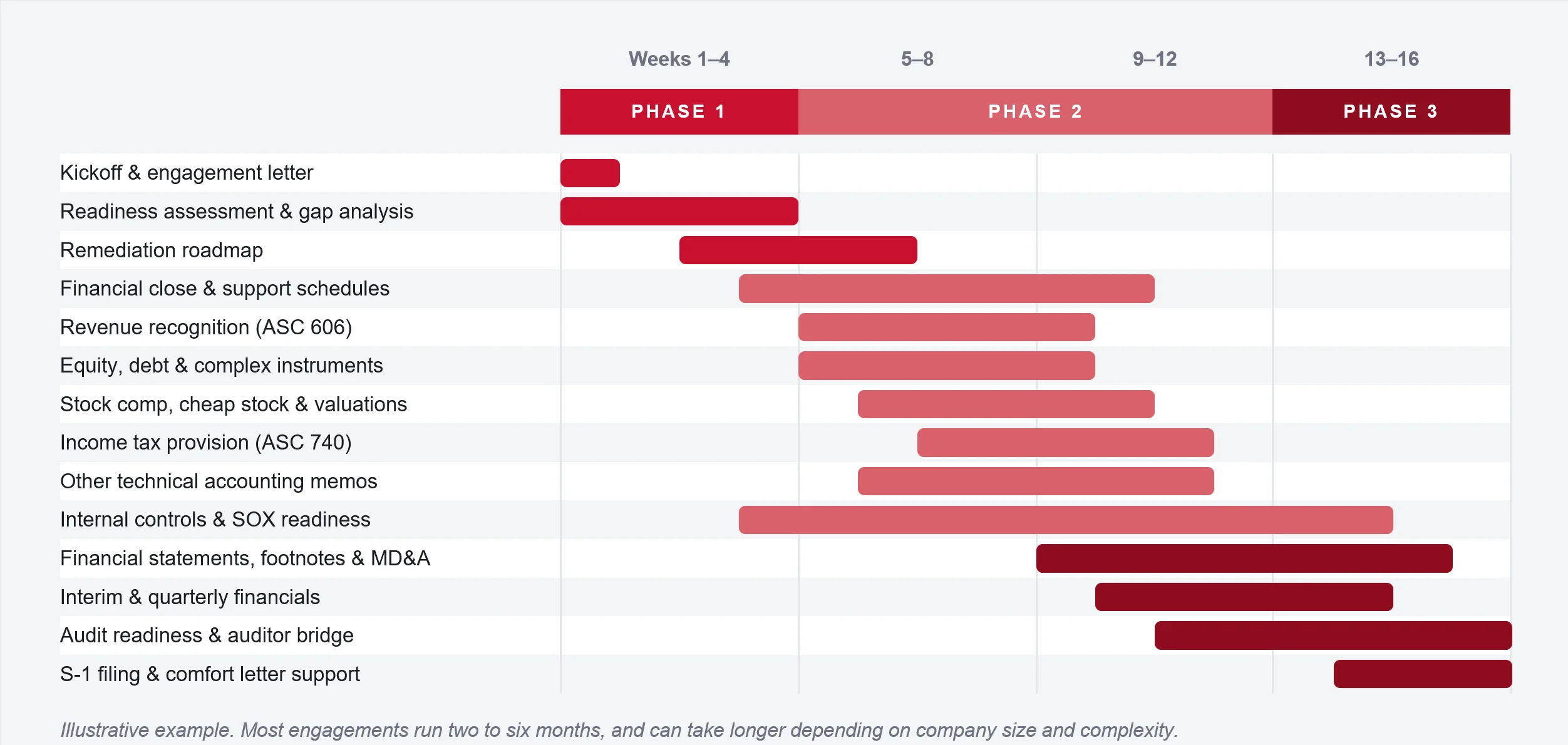
Readiness depends on a schedule built backward from a target filing date. The reference timeline below covers sixteen weeks across three phases: gap assessment and the PCAOB audit uplift first, because the audit gates everything; the position memos, controls, tax provision, and close work in the middle; and the S-1 drafting, interim-stub reviews, and comfort-letter support at the end. The close-process work starts in week one, because every later workstream, the audit, the interim stubs, and the comfort letters, consumes monthly closes as raw material. Most companies run longer than sixteen weeks; what matters is the sequencing and the dependencies.
The 16-week reference timeline and its dependencies. Illustrative.
Before the gap work
The path decision sets the readiness calendar
Readiness is the same six areas of work whichever path you take, but the path, a traditional IPO, a SPAC merger, or a direct listing, sets the calendar and the pressure on that work. A SPAC merger front-loads the same accounting into a fixed closing date and adds the S-4 and the Super 8-K, so it is hardest on a company that is not ready. A direct listing removes the underwritten offering but leaves the S-1, the PCAOB audit, and the readiness bar identical. The comparison below is the decision we run before the gap work begins; the full treatment is on our going public advisory page.
The paths to a public listing, compared. Illustrative.
What the filing must contain
EGC and SRC status changes what readiness requires
Which scaled-disclosure reliefs you qualify for changes the readiness work directly. Emerging growth company status cuts the audited financial statements from three years to two, the single biggest lever on audit scope, and defers the 404(b) auditor attestation for up to five years, though the controls still have to exist. Smaller reporting company status scales the disclosure further. Confirm the status early, because it sets how many years the audit covers and how much of the controls and disclosure apparatus the first filing needs. The qualification thresholds and each relief are below; the elections are covered on our going public advisory page.
EGC and SRC reliefs and who qualifies. Illustrative.
Where readiness leads
How the readiness work feeds the S-1 filing timeline
The readiness work exists to reach an effective S-1, and the filing has its own timeline the gap work has to be finished ahead of. A confidential draft goes in first, the SEC’s first comment letter arrives about thirty days later, the filing goes public at least fifteen days before the roadshow, and effectiveness comes under Rule 430A with the price omitted. Running in parallel, FINRA clears the underwriting compensation, the exchange processes the listing, and the Regulation S-X 3-12 staleness clock forces an interim stub past 134 days. Miss a staleness date and the filing waits for the next set of financials. The full document build is on our Form S-1 preparation page.
The S-1 filing timeline, from confidential draft to final prospectus. Illustrative.
The long pole
The financial statements the S-1 requires
The financial statements are the long pole of readiness, so it is worth seeing exactly what the S-1 demands. The registrant needs audited annual statements, two years for the emerging growth companies most issuers qualify as, or three otherwise, audited under PCAOB standards by a registered firm, plus a reviewed interim stub inside the staleness windows. Private books change when they become F-pages: the audit is re-performed under PCAOB standards, the company unwinds its private-company accounting alternatives, new standards adopt on the public timeline, and the footnotes add segment, EPS, fair-value, and tax-rate-reconciliation disclosures private GAAP omits. This is the gap the readiness assessment scores first; the detail is on our Form S-1 preparation page.
The registrant's financial statements in an S-1. Illustrative.
This is for you if
You are twelve to twenty-four months from a planned listing and want to know exactly where you stand.
Your existing audits are not PCAOB audits and the uplift needs to start.
Bankers or investors have asked readiness questions your team could not answer with documents.
You are choosing between an IPO, a SPAC merger, or a direct listing and want the accounting workload compared honestly.
What you get
Readiness assessment and roadmap A scored gap analysis across the six areas and a sequenced remediation plan with owners and dates.
S-1 financial statements The audited-period statements, stubs, and footnotes, with the PCAOB uplift managed alongside.
Position memos and provisions The technical accounting and ASC 740 documentation the audit and the filing both consume.
A public-company close A compressed, documented close that survives the first 10-Q and every one after it.
How We Help
What we deliver
On a readiness engagement, you get the gaps measured, then closed, in the order they gate the filing.
Readiness assessment and roadmapA scored gap analysis across the six areas and a sequenced remediation plan with owners and dates.
S-1 financial statementsThe audited-period statements, stubs, and footnotes, with the PCAOB uplift managed alongside.
Position memos and provisionsThe technical accounting and ASC 740 documentation the audit and the filing both consume.
A public-company closeA compressed, documented close that survives the first 10-Q and every one after it.
When companies bring us in
You are twelve to twenty-four months from a planned listing and want to know exactly where you stand.
Your existing audits are not PCAOB audits and the uplift needs to start.
Bankers or investors have asked readiness questions your team could not answer with documents.
You are choosing between an IPO, a SPAC merger, or a direct listing and want the accounting workload compared honestly.
Free Assessment
How ready are you? Get your IPO Readiness Score™
37 questions across 9 readiness dimensions. Weighted scoring and an instant gap analysis, built by the team that runs the engagements.
Readiness through effectiveness for an advertising technology company: gap assessment, PCAOB audit uplift, revenue and equity position memos, the cheap stock bridge, S-1 financial statements and MD&A support, comfort letter circle-ups, and the standing quarterly close that carried the first 10-Q.
Engagement Notes
Pre-revenue path: energy technology SPAC combination
Readiness for a small modular reactor company entering the public markets through a SPAC merger: the same gap framework applied to a pre-revenue business, where the work concentrated in instrument classification, going-concern and runway disclosure, S-4 financial statements, and standing up reporting for a company whose first public quarters have no revenue cycle to anchor them.
The Detail
The gaps, and how we close each one
Gap 01
Financial statements built to what the S-1 requiresS-1 / Reg S-X
The S-1’s financial statement requirements are specific, and private-company financials almost never meet them as-is: the periods, the audit standard, the footnotes, and the interim stubs all change. This gap is the long pole in nearly every IPO timeline.
The fix
The S-1 requires audited annual financial statements, two years for emerging growth companies and three otherwise, audited under PCAOB standards by a registered firm, which usually means re-audit or uplift of existing AICPA audits. Add unaudited interim statements for the required stub periods, kept inside the staleness windows, full public-company footnotes (EPS, segments, fair value, equity, and the rest), and Regulation S-X compliant schedules. Foreign private issuers file the F-1 with IFRS as issued by the IASB, or local GAAP reconciled to US GAAP. The fix is sequencing: lock the required periods off your target filing date, start the PCAOB audit uplift immediately because it gates everything, and build the footnotes alongside the audit instead of after it. We prepare the statements, footnotes, and support so the auditors test rather than construct.
How we fix it: We prepare the S-1 financial statements, footnotes, and schedules, and manage the PCAOB audit uplift that gates the filing.
From our engagements: The most common surprise in readiness assessments: an existing clean audit that cannot support the S-1 because it was not performed under PCAOB standards. Finding that in month one instead of month nine is worth the assessment by itself.
Gap 02
Technical accounting positions documented before they are questionedASC 606 / 718 / 480
Revenue recognition, equity and convertible instruments, stock compensation, and unusual transactions drive most SEC comments and most pre-IPO restatements. Undocumented positions do not fail because they are wrong; they fail because nobody can show the analysis.
The fix
Inventory the judgment areas and write the position memos before the audit: ASC 606 revenue policies matched to how contracts actually work, SAFEs, converts, warrants, and preferred stock classified under ASC 480 and 815, ASC 718 stock compensation with the cheap stock bridge to the expected offering price, plus any business combinations, consolidation questions, or industry-specific issues. Each memo runs facts, guidance, alternatives, conclusion, and disclosure impact, in the format auditors and, later, SEC reviewers expect to test. The S-1’s MD&A critical accounting estimates section is then written from the memos, so the filing and the workpapers say the same thing.
How we fix it: We inventory the judgment areas and deliver the position memos before the audit, then write the critical estimates disclosure from them.
Gap 03
A control environment scaled to your listing timelineSOX
Undocumented controls will not block your S-1, but they will surface fast afterward: 302 certifications start with your first periodic report, management’s 404(a) assessment follows, and material weaknesses disclosed in the S-1 itself are now common and priced by investors.
The fix
Build the control environment to the actual regulatory sequence rather than all at once: entity-level and close controls first (they support the 302 certifications you sign immediately), then documentation of key cycles under COSO, then the testing program that management’s first 404(a) assessment requires, generally with your second annual report. Emerging growth companies get relief from auditor attestation under 404(b) for up to five years, which changes the investment curve but not the need for a reliable close. If a material weakness exists at filing, disclose it with a credible remediation plan; the disclosure is survivable, an undisclosed weakness discovered later is not. We design the framework a lean team can actually operate, sequenced to your dates.
How we fix it: We build the control framework in regulatory sequence: certification-critical controls first, then cycles, then the testing program.
Want to know which of these gaps you have? Start with the free assessment below, or talk to us directly.
Tax provision and structure ready for public scrutinyASC 740
Many private companies have never prepared a full ASC 740 provision, and the S-1 requires one for every audited period: deferred taxes, valuation allowances, uncertain positions, and the rate reconciliation, plus a structure that survives diligence.
The fix
Build the provision history the filing needs: current and deferred taxes for each presented period, valuation allowance analysis with the positive and negative evidence documented (most pre-profit issuers carry full allowances, and the release timing later becomes its own judgment), uncertain tax position inventory, and state and foreign footprints reconciled. Structural items surface here too: Up-C structures and tax receivable agreements, Section 382 limitations on NOLs after funding rounds, and equity compensation deductions. The provision workpapers become audit support and the tax footnote simultaneously. Start this workstream early; rebuilding three years of provisions is slow, and it sits directly on the audit path.
How we fix it: We build the ASC 740 provisions for every presented period and the valuation allowance and structure analysis behind them.
Gap 05
Governance, audit committee, and the disclosure apparatusListing standards
Exchange listing standards and SEC rules require governance most private companies have not built: an audit committee with independence and financial expertise, formal policies, and a disclosure process that can stand behind certifications every quarter.
The fix
Stand up the pieces on the exchange’s phase-in schedule: an audit committee meeting independence requirements with at least one financial expert (fully independent within a year of listing), a disclosure committee and sub-certification process feeding the 302 certifications, and the policy set: related party transactions, whistleblower, insider trading with 10b5-1 awareness, and a Reg FD posture before the roadshow. The audit committee also formally owns the auditor relationship, so its charter and calendar need to exist before effectiveness, not after. We support the finance side of this: the reporting the committee reviews, the sub-certification design, and the related-party inventory the S-1 will disclose.
How we fix it: We support the finance side of governance: audit committee reporting, sub-certification design, and the related-party inventory the S-1 discloses.
Gap 06
The close process and team that quarterly reporting demandsOperations
A public company closes and files on statutory deadlines every quarter, forever. A close that takes six weeks, key-person spreadsheets, and systems that cannot produce footnote support are readiness gaps as real as any accounting position, and they surface in the first 10-Q.
The fix
Compress and harden the close: a documented close calendar with owners targeting a timeline that supports the 10-Q deadline with review and auditor time built in, reconciliations standardized, footnote support (EPS, equity rollforwards, segment data, fair value tables) produced by the process rather than assembled after it, and the reporting calendar for the first four quarters mapped before pricing. Staff honestly: most issuers add SEC reporting capability, by hire or by outsourcing, before filing. This is also where the S-1 workload and the ongoing business collide, so plan the team for both. We frequently run the close and reporting alongside the readiness workstream so the internal team is not doing two jobs.
How we fix it: We compress the close, build the footnote support into the process, and can run reporting alongside your team so the S-1 does not stall the business.
From our engagements: In our sixteen-week reference timeline, the close process work starts in week one, because every later workstream, audit, stubs, comfort letters, consumes closes as raw material.
FAQ
Frequently asked questions
What does a readiness engagement involve?
A full gap analysis of your finance function, then a remediation roadmap. We prepare the financial statements, footnotes, and technical accounting memos, plus the S-1 sections, Regulation S-X tables, and MD&A.
What are the most difficult parts of IPO readiness?
The technical judgment areas: revenue recognition, equity versus debt, business combinations, and supporting valuations. These drive most SEC comments and restatements, so we resolve them first.
How many years of financials do we need?
Usually two years of audited financials, sometimes three. Most first-time issuers qualify as emerging growth companies and can file two years instead of three. The opening balance sheet is always audited, so historical equity, goodwill, and other balance-sheet items are examined too.
How does this work with our external auditor?
We bridge your team and the auditors, preparing the workpapers, schedules, and memos they test and managing their request list. Independence rules keep the roles separate; we sit on your side.
Do you support foreign private issuers?
Yes. We regularly work with foreign private issuers entering the US markets, handling IFRS financial statements, IFRS-to-US GAAP reconciliations where required, and Form F-1 or F-4 registration statements.
How long does it take, and what does it cost?
Most projects run two to six months, longer for larger or more complex companies. Fees are fixed to a pre-defined scope: simpler projects start around $50,000, larger ones significantly more.
When do we need to be SOX-compliant?
Full 404(b) attestation usually has a grace period after listing, but you need a reliable control environment from day one. We design and document a control framework that fits your stage.
How do we get started, and how quickly?
Four steps: a discovery and scoping call, a statement of work with deliverables and fees, secure read-only data-room access, and kickoff. We typically mobilize within a few business days of signing.
Audit standard.PCAOB auditing standards: the standard the S-1 audit must meet, usually reached by uplift or re-audit.
Internal control over financial reporting.SOX Section 404: management’s assessment and the 404(b) auditor attestation.
Audit committee.Exchange Act Rule 10A-3: the independence and responsibility standards for a listed-company audit committee.
Emerging growth companies.Securities Act Section 2(a)(19) and the JOBS Act: the EGC definition and the two-year and 404(b) reliefs.
Income taxes. ASC 740: the provision, deferred taxes, valuation allowances, and the rate reconciliation the S-1 requires for each presented period.
This page summarizes SEC rules and staff guidance for general information, and is not accounting or legal advice. Rules change; confirm the current text before you rely on it.